
The 2027 Luxor Solar Eclipse: How to Plan It Yourself (Without a $7,000 Package)
On 2 August 2027, the Moon will cover the Sun completely for 6 minutes and 23 seconds directly over Luxor, Egypt — the longest totality anyone alive today is likely to witness on land. If you want to be standing under it, the honest answer is that you should be planning now, roughly one year out, because Luxor's hotel rooms are effectively already sold, and the packages still available are asking between $4,150 and $7,400 per person.
That price tag is where most people stop reading and quietly give up. This guide is for the ones who don't. You do not need a seven-thousand-dollar package to see this eclipse. You need to understand why the inventory disappeared, where the space actually still is, and who to book it with directly.
Quick summary
- The event: total solar eclipse, 2 August 2027, with Luxor sitting close to the centerline and an estimated 80% chance of clear skies — statistically one of the best eclipse-viewing locations on Earth.
- The problem: Luxor's hotels sold out more than a year ahead, rooms that normally go for $80 a night are being listed at $200–$400+, and fake "waitlists" are already circulating.
- The way through: stay in the West Bank villages and the smaller towns along the Nile that are still inside the path of totality, and book beds, guides and transport directly with local hosts instead of buying a bundled package.
Why every hotel room in Luxor vanished before you heard about it
Eclipse travel runs on a different clock than normal travel. Astronomy societies, university alumni programmes and specialist eclipse operators block-book entire properties three to five years out — long before a hotel would open the same dates to the public. By the time the big chains release general inventory, usually around the twelve-month mark, the good rooms in Luxor city have already been contracted away.
The result is a market that looks broken from the outside. Boutique properties on the Luxor West Bank have been fully committed for eclipse week since early 2026, with waiting lists. Larger hotels are quoting three to five times their normal rate. And because demand is loud and supply is invisible, a layer of scams has grown on top: deposit-taking "waitlists" that do not correspond to any real contracted room, and operators selling Luxor accommodation they have never actually held.
Here is the part the sold-out headlines leave out. Luxor city is not the eclipse. The path of totality on 2 August 2027 is hundreds of kilometres wide. It sweeps across southern Egypt, and Luxor happens to be the famous name inside it. Esna, Armant, the farming villages of the West Bank, and the Dendera area up near Qena are all inside that shadow too. They have beds. They are not sold out. They are simply not on the spreadsheets of international eclipse operators.
Where to actually stay for the 2027 eclipse in Upper Egypt
The West Bank villages: Al-Qurna, Al-Ba'irat and Gezira
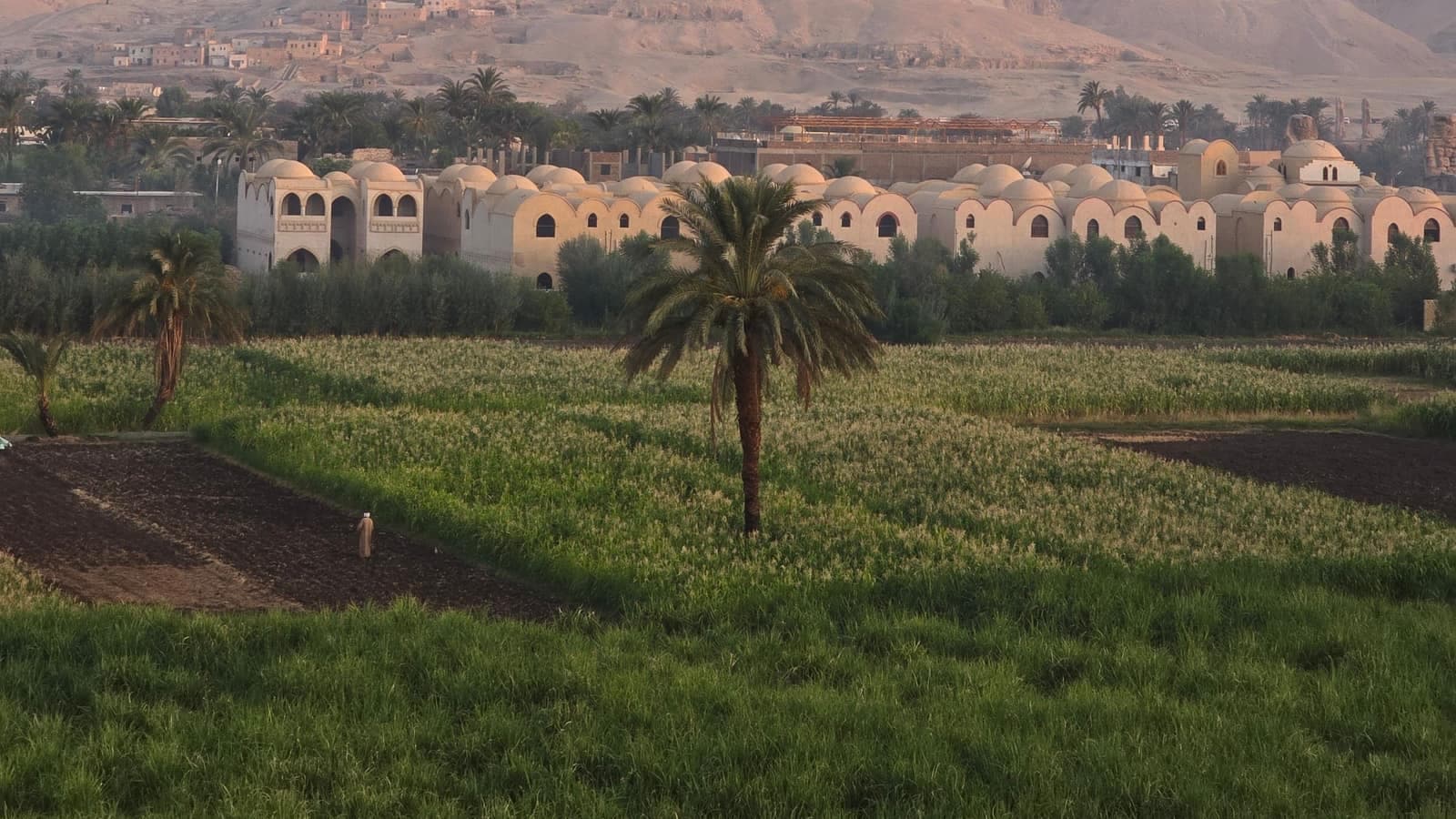
Cross the Nile from Luxor and the whole economics of the trip changes. The villages strung along the edge of the cultivation — Al-Qurna beneath the Theban hills, Al-Ba'irat, and Gezira near the ferry landing — are where a lot of the guides, drivers and archaeologists actually live. Guesthouses here are family-run, often four to eight rooms, with flat roofs that look straight at the western desert.
A rooftop in Al-Qurna on eclipse morning is, objectively, a better viewing platform than a hotel ballroom in Luxor city. No crowd management, no coach schedule, no 400 people trying to photograph the same corona. Just the Colossi of Memnon somewhere off to your left, the hills going the colour of a bruise, and the village dogs losing their minds when the temperature drops.
Esna and Armant: the overlooked towns south of Luxor
Esna, about 55 kilometres south of Luxor, has spent the last few years quietly restoring the Temple of Khnum, whose ceiling colours came back astonishingly vivid after cleaning. The old caravanserai and the covered market street have been rehabilitated, and a handful of small guesthouses have opened. Armant, closer in, is a working sugar-cane town most travellers blow past on the road. Both sit inside totality. Both are an hour or less from Luxor's West Bank by road.
Dendera and the Qena corridor
North of Luxor, the Temple of Hathor at Dendera has one of the best-preserved painted ceilings in the country, including the astronomical ceiling — which, for an eclipse trip, is a piece of thematic luck almost too neat to be real. The Qena area is well inside the path, far cheaper than Luxor, and largely ignored by eclipse tourism.
What to avoid
Do not plan to arrive in Luxor on 1 August 2027 and find a walk-in room. That will not work. Do not pay a deposit to any "waitlist" that cannot name the specific property and show you a contract. And do not book a Nile cruise cabin for eclipse morning without confirming exactly where the boat will be moored — a hull parked on the wrong bank with a hill in the way is an expensive way to miss six minutes.
Booking direct: the case against the bundled package
A $4,750 eclipse package is mostly not the eclipse. It is a coach, a fixed itinerary, a group of forty, a contracted room with a large markup on it, and a guide you did not choose. The eclipse itself is free and happens whether you paid for it or not.
Built the other way — a village guesthouse, a driver you booked yourself, a Theban guide for two days, a felucca afternoon in Aswan — the same eight nights lands in a very different place financially, and in a completely different place emotionally. You are not a passenger on someone else's schedule. You are a guest in a village that has been reading the sky over those hills for four thousand years.
This is exactly the gap Rafiky was built for. Instead of buying a sealed package, you book the individual pieces from the people who actually provide them — the guide, the cook, the boat captain, the host — and the money lands in Al-Qurna instead of a booking platform's balance sheet. You can browse Upper Egypt hosts on Rafiky Experiences and assemble the trip yourself.
The people you would actually be staying with
The guides working the West Bank tend to come from third- and fourth-generation Theban families. Grandfathers worked the excavation seasons in the Valley of the Kings; fathers drove for the archaeological missions at Deir el-Medina. Someone who grew up two hundred metres from Medinet Habu can tell you which hour of which month the light hits the Ramesses III reliefs properly, which is not information that exists in a guidebook.
A few of them, for reasons that started as a hobby, keep a telescope on the roof. On clear winter nights it comes out for guests with mint tea and a running commentary that drifts between Orion and opinions on Egyptian football. For August 2027 some hosts are holding rooftop space rather than selling a package, because — as one of them put it — nobody should have to pay four thousand dollars to look up.
That is the kind of host Rafiky exists to put in front of travellers. Not a product. A person, on a specific roof, in a specific village.
Building the trip: a realistic one-year timeline
Twelve to nine months out (now through late 2026)
Lock accommodation first — it is the only genuinely scarce thing. Decide your viewing location before you book flights, because the difference between a West Bank rooftop and a Luxor city hotel is the difference between the trip you wanted and the trip you settled for. Get written confirmation, not a waitlist position.
Nine to six months out (late 2026 through early 2027)
Book internal transport. Egyptian domestic flights to Luxor and the sleeper train from Cairo will both be under pressure that week. Confirm your guide and driver for the days around the eclipse, and build in slack — arriving 30 July rather than 1 August turns a logistics gamble into a rest day.
Six months out and after
Fill in the rest of the trip. Most people flying to Egypt for an eclipse are not flying home two days later. Aswan, Elephantine Island and the Nubian villages of Gharb Soheil are about three and a half hours south by train. Kom Ombo and Edfu sit on the way. This is where a slow-travel itinerary beats an eclipse package decisively — the package ends when the shadow passes, and yours does not have to.
What August in Upper Egypt is actually like
It will be extremely hot. Luxor in early August regularly runs past 40°C, and the West Bank has no shade to speak of between the tombs. This is genuinely the hardest month to travel Upper Egypt, and anyone telling you otherwise is selling something.
The workaround is the one locals have used forever: live at the edges of the day. Sites from 6am, back indoors by 11, out again at five. Sleep or read through the middle. Eclipse day itself has a strange gift built in — as totality approaches, the ambient temperature drops noticeably, birds go quiet, and for a few minutes the Theban hills do something with light that nobody who has seen it describes well.
Bring certified eclipse glasses from home. Do not plan to buy them in Egypt, and do not trust anything sold from a table outside Karnak that week.
Frequently asked questions
Is it too late to plan the 2027 Luxor eclipse if I start in August 2026?
No — but you have lost the easy options. Luxor city hotels and the well-known West Bank boutiques are gone. What remains, and remains for a while yet, is village guesthouse accommodation on the West Bank and in Esna, Armant and the Qena area, all of which sit inside the path of totality. Booking those directly with the hosts is the realistic route from here.
How much should the trip actually cost?
Packages are advertising $4,150 to $7,400 per person. Assembled independently — village guesthouse, your own guide and driver, domestic transport, food — the same length of trip generally lands at a fraction of that, with the difference being that you are paying providers rather than intermediaries. The variable that matters most is how early you confirm the bed.
Do I have to be in Luxor itself to see totality?
No, and this is the single most useful thing to understand. Luxor is close to the centerline, which is why it dominates the coverage, but the path of totality is hundreds of kilometres wide across southern Egypt. Esna, Armant, the West Bank villages and the Dendera–Qena corridor are all inside it. Being 40 kilometres from Luxor city costs you a handful of seconds of totality and saves you a great deal of money and crowding.
Is it safe and sensible to travel Upper Egypt independently?
Yes, with preparation. The genuine friction independent travellers report in Egypt is not danger so much as constant commercial pressure — touts, aggressive pricing, unclear expectations. Almost all of it dissolves when you arrive with a host who knows you, a driver who is already booked, and prices agreed in advance. That is the entire argument for booking with named local providers rather than improvising on arrival.
What if it is cloudy?
The Luxor region carries roughly an 80% probability of clear skies for early August, which is why astronomers converged on it in the first place. It is among the best odds available anywhere along the 2027 path. Not a guarantee — but if you are going to gamble six minutes of your life on a weather statistic, this is a good one.
The last thing worth saying
There is something worth sitting with in the fact that the best place on Earth to watch the sky go dark in 2027 is a valley where people have been recording exactly this kind of event, on ceilings and coffin lids, for four millennia. The astronomical ceiling at Dendera is a star map. The people who painted it were doing what you will be doing: standing in the heat, looking up, trying to make sense of it.
You can experience that from a coach window with forty strangers, or from a rooftop in Al-Qurna with a family who will feed you afterwards. Both are technically the same eclipse. Only one of them is a memory.
Start with the people. Find hosts, guides and rooftops across Luxor and Upper Egypt on Rafiky Experiences, and build the trip from there.